
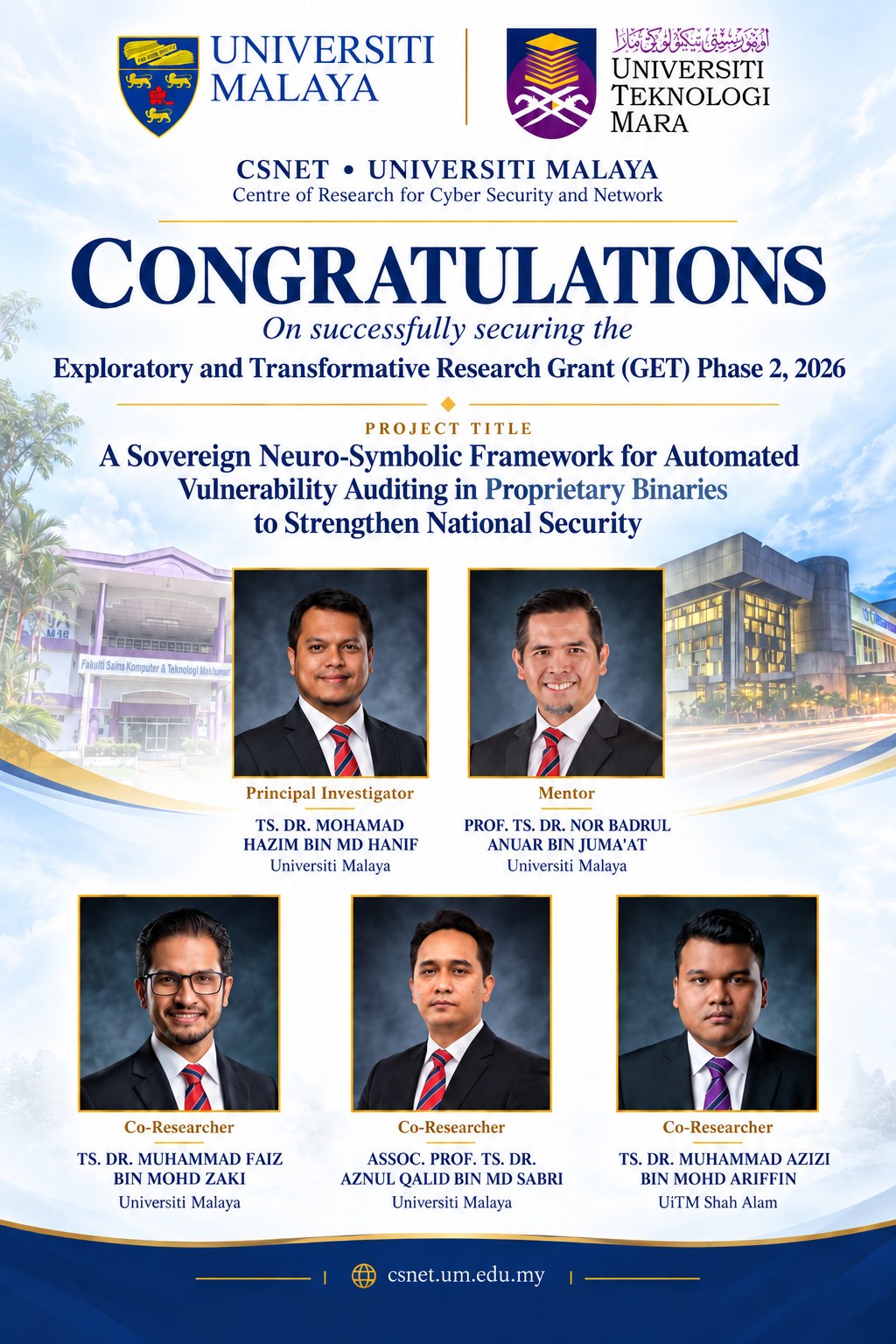
The research team from Universiti Malaya and Universiti Teknologi MARA.
CSNET congratulates the research team led by Ts. Dr. Mohamad Hazim Bin Md Hanif on securing the Exploratory and Transformative Research Grant (GET) Phase 2, 2026 from the Ministry of Higher Education (MOHE).
The project, "A Sovereign Neuro-Symbolic Framework for Automated Vulnerability Auditing in Proprietary Binaries to Strengthen National Security", will develop a framework that audits compiled, closed-source software for security vulnerabilities automatically, even when its source code is not available. It brings together neural models, which learn patterns from large amounts of code, and symbolic reasoning, which follows explicit rules that analysts can check, so that every finding can be explained.
Why It Matters
Government agencies and critical infrastructure depend on proprietary software they cannot inspect line by line. Finding weaknesses in that software before attackers do is a national security concern. The project builds on CSNET's research in AI-driven vulnerability detection and its move towards agentic security, where AI systems analyse and respond to threats on their own.
The Research Team
- Principal Investigator: Ts. Dr. Mohamad Hazim Bin Md Hanif, Universiti Malaya
- Mentor: Prof. Ts. Dr. Nor Badrul Anuar Bin Juma'at, Universiti Malaya
- Co-Researcher: Ts. Dr. Muhammad Faiz Bin Mohd Zaki, Universiti Malaya
- Co-Researcher: Assoc. Prof. Ts. Dr. Aznul Qalid Bin Md Sabri, Universiti Malaya
- Co-Researcher: Ts. Dr. Muhammad Azizi Bin Mohd Ariffin, Universiti Teknologi MARA (UiTM) Shah Alam
Ts. Dr. Muhammad Azizi, a CSNET PhD graduate (2025), joins the team as a CSNET satellite member at UiTM, extending the collaboration between the two universities.
About the GET Grant
The Exploratory and Transformative Research Grant (Geran Eksploratori dan Transformatif, GET) was introduced by MOHE through the Department of Higher Education (JPT) in 2026 as an evolution of the Fundamental Research Grant Scheme (FRGS). It funds high-impact projects of two to three years that align with the Thirteenth Malaysia Plan (RMK13), with an emphasis on collaboration and demonstrable downstream impact. Its research areas include Future Digital and Technological Changes and National Security.
Congratulations to the team. We look forward to sharing the results of this work.